| |
|
|
Six recent recordings on Bridge Records:
David Holzman on Bridge Records
(These and other recordings are described individually below:)
|
|
| Musical Connections |
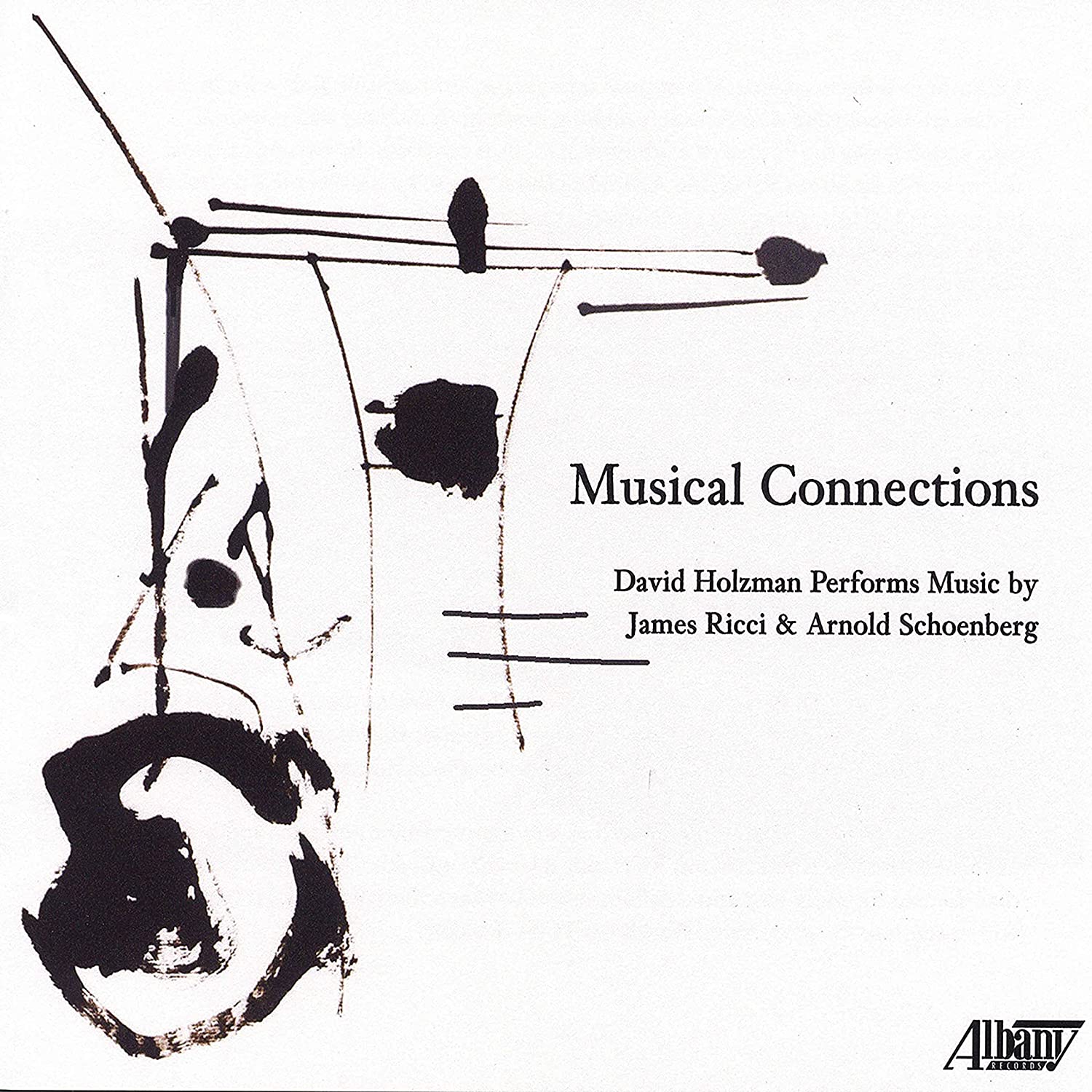
Troy #1875
www.AlbanyRecords.com
|
Featuring David Holzman on piano.
Piano Music of James Ricci and Arnold Schoenberg |
All Compositions
by James Ricci, except where noted:
|
| Bagatelle (2014) |
| Nocturne (2014) |
| Sonata
(2014) |
| Nocturne 2 (2015) |
Five Pieces
for Piano, Op. 23
by Arnold Schoenberg |
Waltz (2005)
|
| Song without Words (2005) |
| Intermezzo (2014) |
| Fantasy Variations (2016) |
| Boogie Woogie (2006) |
|
|
"The revered pianist David Holzman takes on a
daring project here, where he performs the music of
James Ricci and Arnold Schoenberg, and though many of
the songs were recorded years apart, the entire listen
flows together quite cohesively. The album leads with
Ricci's vision of modernism, as Bagatelle starts the
listen with Holzman's stunning finger acrobatics that
make for a warm and diverse opener, and this talent
continues to the stirring intimacy of Nocturne, as
well as the bare but flowing progression of Sonata. In
the middle spot, Schoenberg's work is highlighted across
Five Pieces For Piano, Op. 23, where the key
manipulation varies from serene and pretty to jumpy and
energetic, and the technical aspects are quite stunning
and easily absorbed. Ricci exits the listen, and
includes the aptly titled Waltz while the fluid melody
of Song Without Words makes this the album's best.
Boogie Woogie exits the listen with a charming
delivery of rumbling and lively piano that will get your
body moving to the jazz fueled finish. Holzman's
performance is nothing short of captivating on this
album, and though some of these songs are nearly 100
years old, he illuminates their timeless nature
flawlessly in his inimitable vision."
|
|
—Take Effect
|
|
"Juxtaposing the music of James Ricci and Arnold
Schönberg, while understandably quite stylistically
appropriate and musically intriguing, is at the same
time a little reductive. Declaring himself as a
modernist composer, Mr. Ricci at least deserves
comparison to many other composers of the period of
modernism, like Arthur Louriè, the silver age composers
of Leningrad, Viktor Ullman, and many others. Everybody
certainly has the right to write in the style he feels
is the most adequate to express himself, but in other
forms of art, this is politely called d'apres. So if we
had one Caravaggio, who created an entirely new painting
style, we then had the scuola Caravaggesca, with
hundreds of painters copying this style until rendering
it pale and insignificant. There is a risk of using a
twelve-tone, dodecaphonic technique nearly one hundred
years after its invention -- a way of composing largely
abandoned by today's composers. Still, this music has a
charm of its own because what was once called
'modernist' is today perceived as extremely 'old
school,' and maybe through this acquires a flair in
itself. The lucky combination of finding in Mr. Holzman
an ideal interpreter who can deliver these steel-like
cascades of cold notes, wholly deprived of any sentiment
or romantic expressiveness, mixed with the fantastic
work of the sound engineers, is a winning one..."
|
|
—EarRelevant
|
|
| At All Device |
Bridge #9528
www.BridgeRecords.com
|
David Holzman Plays Piano Music by John
McDonald
|
| Something
Bold to Start With, Op. 541, No. 64 (2014) |
| Nervous
Waiting (Tetradactyllic), Op. 455, No. 23 (2010) |
| You Don't
Love Me, Op. 446, No. 12 (2009) |
| Three-Parter,
Op. 455, No. 102 (2010/11) |
Variants On
Jim Wilson's Lanterne Melody 1,
Op. 455, No. 28 (2010) |
| Epicede for
Louise Bourgeois, Op. 455, No. 38 (2010) |
| Poco "Harsh,"
Poco "Nice," Op. 455, No. 74 (2010) |
Digital Dance
Fetish: An African Allegro, Op. 455 No. 118
(2010/11) |
| Lento
Appassionato for David Holzman, Op. 475, No. 163
(2011) |
| Monet's
Anguish, Op. 420, No. 49 (2006) |
| Moonesinghe
Obsequy, Op. 388 (2002-3) |
| To Play With
No Devices, Op. 592, No. 59 (2016) |
Berceuse To
Play With Two Devices, Op. 592, No. 101 (2016-17)
|
Forthright
Wednesday Poem Composed After hearing
Palestinian
Notebook (As Recorded By D. Holzman),
Op.
475, No. 212 (2011) |
| Held Dear,
Op. 614, No. 7 (2017) |
| Offering in
Tribute, Op. 420, No. 6 (2006) |
| Deep
Disappointment, Op. 614, No. 2 (2017) |
|
|
"McDonald is close to pianist David Holzman and has
written some of these works specifically for him. One is
Three-Parter, which manages to squeeze its three
sections, almost movements, into less than four minutes.
It is a gentle and lovely piece. Another work written
for Holzman is Digital Dance Fetish: An African Allegro,
a score demanding great virtuosity and marked by
obsessive repetition. ...A disc containing 17 short pieces,
only one longer than four minutes, must provide a
variety of mood, color, and tempo in order to hold the
listener's attention. McDonald's music and Holzman's
sympathetic performances combine to do that."
|
|
—Fanfare
April 30, 2020
|
|
"McDonald has carved out a place for himself in the field
that is defined by the craft, sincerity, and integrity
of his voice and vision. If there is any composer of
whom he reminds me (and I've said this earlier), it's
György Kurtág -- for the jeweled economy of the pieces,
their Modernist intensity, and their focus on the piano.
And from me, that's high praise indeed..."
|
|
—Robert Carl
Fanfare
|
|
"The recorded sound is first-rate, recreating the
atmosphere of hearing these works in a smaller room,
perhaps at a gathering of the composer and his friends.
As I mentioned, McDonald's (and Holzman's) liner notes
are engaging, informative, and often quite touching. To
be sure, this recital will not be everyone's cup of tea.
But I think the music-making by both composer and
interpreter are of a very high level, indeed.
Recommended to the somewhat adventurous."
|
|
—Ken Meltzer
Fanfare
|
|
| Roger Sessions: Music for Violin and
Piano |
| featuring David
Holzman on piano and David Bowlin on violin: |
Duo(1942)
|
| Adagio(1947) |
 |
| Waltz for Brenda(1936) |
| Sonata for Violin(1953) |
| Second Sonata(1946) |
| |
|
|
Bridge #9453
www.BridgeRecords.com
|
|
"Violinist David Bowlin and pianist David Holzman
emphasize the intense emotional expressions of the music,
which are easily overlooked in theoretical discussions, and
their passionate and moody playing shows how Sessions'
works can be quite affecting, despite their reputation for
difficulty. While this album is of immediate interest to
students of his work, adventurous listeners should try out
Second Sonata for the bracing performance, and
Sonata for Violin for a concentrated display of Sessions'
lyricism and motivic invention."
|
|
—Blair Sanderson
AllMusic
|
|
"Roger Sessions was probably more influential as a
pedagogue than a composer, but the robust and astringent
pleasures of his music shouldn’t be overlooked. Those are
bountifully evident in this collection of chamber works for
piano (Adagio, Waltz for Brenda, Second
Sonata), for violin
(Sonata for Violin) and for the two instruments together (a
one-movement duet). Here we see Sessions moving from a
complicated and ambivalent tonality — note in particular the
gentle but knotty Waltz for Brenda — into the full-fledged
duodecaphony of his notoriously difficult Sonata for
Violin. Bowlin and Holzman are both masterful advocates for
this music, and are beautifully recorded.
"
|
|
—Rick
Anderson
CD
HotList
November 2, 2015
|
|
| Poul Ruders Edition, Volume 9 |
| featuring David
Holzman: |
 |
Twinkle Bells
(Piano Etude No. 2) (2012)
(written for Mr. Holzman) |
| 13 Postludes
(1988) |
| plus chamber
works performed by others |
| |
|
|
Bridge #9427
www.BridgeRecords.com
|
|
"Postludes is the longest work and is for solo
piano. It's
also the oldest and rather uncompromising. Here again
contrasts seem to be all a part of the structure. For
example the first two lead into a wild Toccata. The still,
central point of the cycle comes with the Lacrimosa (number
seven) but that is immediately followed by a frenzied
Preambulum. This sets off another sequence mirrored by an
almost impressionist Romance, immediately followed by a
wild and angry Manége. Emotions now drained, the ensuing
Epilogue seems aimless and the longest
Postlude ends the
cycle with a Feldman-like Requiem, but to what or whom?
This is a fine and moving work and, it seems, a significant
one for the composer. David Holzman is quite brilliant and
captures the differing moods with panache."
|
|
—Gary Higginson
|
|
MusicWeb International
|
|
"The pianist David Holzman conquers the composer's
moody, fitful, and dazzling 13 Preludes for Piano.
And his performances of Twinkle Bells makes this
short etude seem a dream-come-true encore piece for a piano
recital."
|
|
—Anthony Tommasini, The New York
Times, 10/1/14
|
|
| Music of Stefan Wolpe, Vol. 6 |
| |
Four Studies on
Basic Rows (1935-36) |
| |
Three Pieces for
Youngsters (1950) |
| |
Lied, Anrede,
Hymnus, Strophe zarteste Bewegung (1939) |
| |
Toccata in Three
Parts (1941) |
| |
Studies for
Piano, Part 1, Displaced Spaces (1946-48) |
 |
| |
Studies for
Piano, Part 2 (1948) |
| |
Two Dances for
Piano (1926) |
| |
Palestinian
Notebook (1939) |
| |
Songs Without
Words (1959) |
|
Bridge #9344
www.BridgeRecords.com
|
| "Both comparisons for the
'Passacaglia' come as part of contrasting recitals that
more fully survey the totality of Wolpe's piano output.
While [one performer's] virtuosity and [another's]
eloquence are fully at the service of this music, neither
evinces quite the insight and panache of Holzman or is
recorded with such visceral immediacy. Nor could the
booklet, interleaving the pianist's own commentaries with
biographical insights from Wolpe authority Austin
Clarkson, be bettered in terms of 'setting the scene'.
Combative and demanding yet also communicative and
inviting, this music, and this disc, deserves the widest
dissemination."
|
|
—
Richard Whitehouse, International Record Review
|
| "Passacaglia is a masterly
construction of tempestuous drama and
brooding introspection. Mr. Holzman's ability to bring
clarity to the dense counterpoint and thick textures is
remarkable. An entirely different interpretation from
Peter Serkin's excellent 1986 recording on the New World
label, Holzman brings an earthiness to this important work."
|
|
—
Stephen Clarke, WholeNote
|
|
This excellent series of music by Stefan Wolpe, whose
life spanned the first three quarters of the last century,
continues both to perplex and to delight. To perplex
because the musical character of German exile to Palestine
Wolpe was so complex, enigmatic and diverse. To delight
because of the very high quality both of that intriguing
music and its playing.
Indeed, David Holzman's first CD in the series (BRIDGE
9116) in 2003 was nominated for 'Best Solo Instrumental
Performance' in that year's Grammys and did in fact go on
to win AFIM's INDIE award as 'Best Classical CD'. The
current recital has all the vigour, perception and
delicacy of his earlier success. The music played here was
written between 1926 - before Wolpe and Irma Schoenberg
(1902-1984) emigrated to Palestine, in 1934 - and 1959
only just over a decade before his death.
Particularly noteworthy is the first complete recording
of Wolpe's huge Four Studies on Basic Rows (1935-36). It
occupies almost half this CD and includes the composer's
most frequently-recorded piano piece, the 'Passacaglia'
[tr.4], which is in turn the longest single movement here
at getting on for a quarter of an hour.
Music representing Wolpe's time in Germany, Palestine
and America is included. It varies in complexity and scope
from the experimental to music written for his students.
So you're getting a mixture, a taster, of Wolpe's output
for the instrument. You're also getting it played by
undeniably the greatest interpreter of Wolpe's keyboard
music alive today.
In his essay for the CD's liner notes, Holzman
describes how he has come to know Wolpe so intimately that
he can detect the composer's most minutely expressed moods
and feelings in his music. Although this is evident from
Holzman's control of tempi, phrasing and timbral nuance,
the pianist is never permissive to the exclusion of the
true musical essence which he's gently intent on
conveying. It's insight and interpretation first, and any
hint of special understanding second. The playing of the
'Passacaglia', for instance, is approached with great
confidence and all the necessary familiarity; Holzman
unshowily brings to the performance his ability to
anticipate and to pace the music yet is as fresh and full
of surprises as can be.
Holzman reveals and commends the depth and breadth as
well as the engaging beauty of these works: Wolpe's
fascination with the colours (literally) of intervals was
never mechanical, forced or self-indulgently indecisive.
Holzman quietly and effectively communicates with great
conviction and confidence the gentle and at times
understated loveliness in music whose titles sound as
though they were mere exercises. They're not. Their range
and originality are impossible to miss thanks to Holzman's
perception and dedication.
His playing is alert and alive. It continually presents
new delights. Listen to the juxtaposition of the
'Pastorale' then 'Con fuoco' of the Two Pieces for Piano
from 1941 [trs. 9, 10]. It's not that they could be by
different composers (Berg then Webern perhaps); nor that
the same composer is as versatile as he clearly is. The
playing succeeds because it's conversant with the wealth
of resources on which Wolpe draws at any one time. These
include moods, light, invention, ties to other formats,
references and original topoi in which Wolpe is so
evidently at home. As a result, what does emerge in
contrasts and parallels somehow has its own logic.
Technically Holzman is flawless. The piano is recorded
nicely forward yet with enough space to allow full air to
the many timbres and palettes it's required to evoke. The
notes, which are nicely informative - especially for
someone new to Wolpe's world - explain the somewhat
relaxed circumstances under which this recital was
prepared and executed. Indeed, there's a spontaneity and
lack of deliberateness to the playing, to the order in
which the pieces are heard and consequently to the
listener's overall delight in this slice of a very
intriguing composer. But this is a freedom which not for a
minute even hints at sacrificing the rigour necessary for
music as demanding as this. The result: an hour and a
quarter's sheer enjoyment and inspiration.
This sixth volume in Bridge's series fulfils the
promise of the others released so far. It's a great
introduction to Wolpe's piano music for those unfamiliar
with it. Since most of the pieces here presented are not
available elsewhere, Holzman's recital will also satisfy
collectors of Wolpe. Don't hesitate.
|
|
—Mark Sealey
|
|
reprinted with permission from
|
|
MusicWeb International
|
|
| Roger Sessions and Ralph Shapey |
| Sessions: |
Piano Sonata No. 1 |
 |
| |
Piano Sonata No. 3 |
| Shapey: |
Mutations |
| |
Mutations II |
| |
12 Variations |
|
Bridge #9243
www.BridgeRecords.com
|
| The
juxtaposition of piano music by two such different composers as Sessions and Shapey is
interesting. It works well on this useful CD thanks to the dynamism and perception of
pianist David Holzman. It's to be welcomed for another reason: it helps to redress the
balance after a period of neglect following their deaths in 1985 and 2002 respectively. It
could be argued that the reputation of each was poorly established even before then and
has been further obscured (by neglect) ever since.
Sessions music is nowhere near so 'difficult' as such a reputation would suggest. His
first Sonata, for example, is lyrical, bouncy almost, sunny and immediate. Holzman plays
its single movement - it lasts almost a quarter of an hour - with measured attack, never
lingering nor yet rushing. He persuades us that there is much to be squeezed from its at
times busy sounding full and rich passages. Holzman invites us to glance back to Ives …
and even to Brahms! … through the eyes, perhaps, of Carter.
Like Messiaen's, the voice of the third sonata (from 35 years later and fully serial)
is rich, packed and dense. Yet Holzman draws out Sessions' assuredness. The composer was
not one to muse aloud or foist his experiments on us as he went along. This music is as
carefully pre-considered as anything by Webern or Bartók. Its compelling beauty is spare
in the first movement; yet we are teased, almost, by the changes in pace and texture. As
it goes on the sonata becomes wilder and more expansive. Yet it never loses a classical
beauty of melodic line for all the furious counterpoint and 12-tone attack. Holzman stays
in perfect control without a hint of woodenness. He is an ideal pianist for this
repertoire: he has not only an amazing technique (and at least 20 fingers); but his
sensitivity to the inner structure of the music is sure and revealing without being overly
'pianistic' as such.
Ralph Shapey came from a different world, in some ways. Proletarian to Sessions gentry,
he was most at home in the Abstract Expressionism of the New York scene. Shapey studied
with Stefan Wolpe but was as close to Feldman (and even Cage) in his interest in
fragmentation, pulsing extracts of sound surrounded by silence as a valid way to move a
work forward. Holzman is - again - completely in accord with this idiom.
Mutations, Mutations II and 21 Variations have in common an
interest in tension and withheld resolution. There is even more of Webern in the condensed
nature of pieces like Mutations [tr.5]. It dictates its own terms of reference and
rules. In that sense it needs to be played almost as an introverted and highly refined and
concentrated interlude. And so Holzman plays it - yet somehow as an inevitable complement
- to the rest of one's day - whose purpose and context can neither be ignored nor
forgotten. Life oozes out of it.
Similarly Mutations II is even sterner. It's hard to tell - even after repeated
listenings - whether Shapey has any peace in mind. Or whether - perhaps like Shostakovich
- he really does despair and simply wants to portray incoherence without limit. Not that
the music lacks direction. Again, that's a strength of Holzman's. It moves towards and
away from centres of gravity tonally. Yet Mutations II does seem to be coming apart in all
other respects.
Nowhere is Holzman's identification with the way Shapey was thinking when he conceived
these pieces clearer, nor is Holzman's expert grasp of the music more stunningly visible,
than towards the end of Mutations [tr.6] - and, for that matter, throughout the whirlwind
Mutations II [tr.7]; those four hands again! Amazing.
21 Variations is much more figurative, chromatic, somewhat less abstract - at least in
conception. The clusters, chords and clamour are as prominent as ever. Yet they are less
the vehicles for the variations' development; more the result. Once again, Holzman is
completely in tune with such an underlying purpose; he pulls out every nuance and subtlety
without losing sight of Shapey's intention. In other words this is a performance where
flourish, virtuosity (however tempting and even inevitable it could have been) is rejected
for insight, patience and authority. Authority of a curious, not a demonstrative, kind.
Both Sessions and Shapey had few misgivings about distilling their reactions towards
their century (and its art, its music) into abstract and almost romantically nostalgic
styles. That, perhaps, is what they have most in common. Not that Holzman is out to build
his performances entirely - or even chiefly - on commonalities. But what each composer's
approach says about the other's is always illuminating from the hands of someone who is so
at home in, and positive about, both. This makes this a special CD with few others
exposing Shapey's music in particular to the same extent. It will not disappoint.
The presentation of this CD with an informative essay by Holzman and a reference to
his lecture on
Shapey is good; it's businesslike and a little severe - but a great background to two
composers who surely deserve reassessment. Outstanding playing like Holzman's here is more
than a giant leap towards that. His total understanding of the music, its context and its
strengths commend it to us not for its perceived difficulty or lamentable obscurity, but
its beauty and power.
|
|
—Mark Sealey
|
|
reprinted with permission from
|
|
MusicWeb International
|
| "Though
this is the last thing I have to say about this release, it should have
been the first. Pianist David Holzman (who also wrote the astonishing notes in
the booklet) is an extraordinarily accomplished performer. That he knows these
works intimately goes without saying. His feeling for this music is evident.
He manages not to approach it mechanically or in a cold, academic manner. He
is the one responsible for making this music so immediate and clear (I would
say he gives this music soul). I recommend this for those of you following
advanced serial (and non-serial) techniques in 20th Century piano. It left me
breathless."
|
|
—American Record Guide
|
| "David
Holzman surely stands among the greatest living exponents of 20th-century
American music. The 58 year old New York pianist's last CD (Music of Wolpe,
BRIDGE 9116) was Grammy nominated, won the 2003 Indie Award for 'Best Classical
CD of the Year', and won a Deems Taylor award. This new disc continues along
that same intensely virtuosic path, with heroic readings of seminal works of
Roger Sessions (1896- 1985) and Ralph Shapey (1921-2002). These performances
simply must be heard to be believed! What distinguishes Holzman's superb
pianism from so many others is his uncommonly deep musical vision which lends
poetry and unity to even the most complex and sprawling structures. Here are
pianism and musicianship of the very highest order." |
|
—Bridge Records
|
"Let
it be said that Sessions (or Shapey) simply couldn't have a better
advocate and interpreter than David Holzman. This disc is one that
elicits the 'Wow' response. The pianist has unerringly steely
technique, but he has an intellect that allows him to grasp confidently the
conception and structural line of this music. He clarifies everything. There
are passages where the dense contrapuntal textures are so well differentiated,
one might assume this was four-hand music (as an example, the fiery,
overflowing explosion of Mutations II has to be heard to be believed. If there
is any drawback, it is that one will not get the most tender or liquid touch
from Holzman (though this does not mean the man can't produce a pianissimo).
The playing is, as I said, 'steely'. But it's a small price to pay for the
passion, control and rigor that I think admirably matches the spirit of both
composers' music. On top of it, the pianist writes suitably challenging,
intellectually chewy notes. And Bridge's sonics are bracingly big and clear.
While a little out of left field, this could be a Want List item for me come
year's end."
|
|
—
Robert Carl, Fanfare Magazine
|
|
| Stefan
Wolpe: Compositions for Piano (1920-1952) |
| Sonata
(1925)* |
|
| Gesang
(1920) |
|
| Tango
(1927) |
for liner notes, see
ESSAYS |
| The
Good Spirit of a Right Cause (1941)* |
 |
| Battle
Piece (1943-47) |
| Waltz
for Merle (1952)* |
| Zemach
Suite (1939) |
|
GRAMMY Award
Nominee--Best Classical Solo Performance
Indie Award - Best Classical Album
ASCAP - Deems Taylor Award- Best Liner Notes |
Bridge #9118
www.BridgeRecords.com
|
| "
For those who dare to venture into the rarefied world of Stefan
Wolpe, they could hardly do better than with this exceptional Bridge
release.
" |
|
—
(Uncle) Dave Lewis, Allmusic
|
|
| Wolpe: |
Battle Piece*; Displaced
Spaces* |
|
| Pleskow: |
Epitaph and Caprice* |
| Greenbaum: |
Mischsprache for Piano and
Tape* |
|
CRI SD
538
|
| "The same intrepid label has just
given us another Great Day by issuing David Holzman's searing
account of another legend, Wolpe's Battle Piece. Elliott
Carter called Battle Piece 'amazing.' It's at least that and so is
Holzman's mighty performance. This is an experience you owe
yourself. You'll never forget it." |
|
—Richard Taruskin, Opus
Magazine
|
| "Mr.
Holzman's recital on Composers' Recordings is one of the great piano
discs of the decade..." |
|
—Peter G. Davis, New
York Magazine
|
|
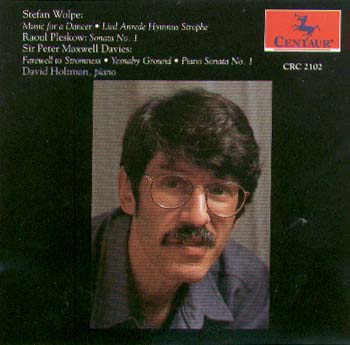
| Wolpe: |
Music for a Dancer*
Lied Anrede Hymnus Strophe* |
 |
| Pleskow: |
Sonata #1* |
| Maxwell Davies: |
Farewell to
Stromness;
Yesnaby Ground; Sonata (excerpts) |
|
Centaur
Records CRC 2102
www.centaurrecords.com |
| "New
York Pianist David Holzman has put together an impressive and
coherent program of important modern piano music not available anywhere
else. He is an eloquent advocate for these three
composers, not only as a pianist but in his literate and helpful
liner notes... throughout the disc, Holzman provides vivid
characterization and contrapuntal clarity.: |
|
—Scott
Wheeler, Fanfare
|
|
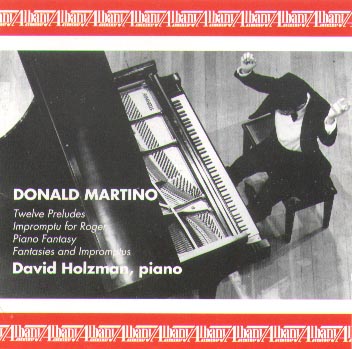
| Martino: |
Fantasy*;
Impromptu for Roger*;
12 Preludes* (excerpts); Fantasies and Impromptus |
|
Albany
Troy 169
|
| Martino: |
Pianississimo |
Albany
Troy 168
|
| "Holzman
is an amazing pianist to listen to, engaging a technique of blazing
accuracy in the service of beautifully expressive playing. The
scores are filled with poetic descriptions of the musical intent
behind the exacting notation and Holzman manages to give equal
weight to the exactitude and to the poetry ...every detail is
employed in the service of communicating meaning on the part of both
the composer and the performer. One special joy is the wonderfully
expressive variety of uses out to the grace note decorations. Both
compact discs include six pages of helpful booklet notes. Holzman's
are particularly lucid." |
|
—Louis
Goldstein, American Music
|
| ",,,anyone
listening to Mr. Holzman's performance of Mr. Martino's compositions
on these Albany CDs will surely admire his sterling qualities of
touch, timing and tone." |
|
—Richard
Taruskin, The New York Times
|
| "The
performances are wonderful throughout." |
|
—Robert
Carl, Fanfare
|
|
| Explorations |
| Boros: |
Mnem* |
 |
| Cornicello: |
Sonata* |
| Yttrehus: |
Explorations* |
| Pleskow: |
Sonata #2* (excerpts) |
| Greenbaum: |
Amulet* |
|
Centaur
Records, CRC 2291
www.centaurrecords.com |
| "[The
music] certainly makes punishing demands on the player, and David
Holzman acquits himself with brilliance, He simply burns the
keyboard up, producing vivid, often thunderous sonorities vividly
captured by Centaur's realistic sound. These fierce, demanding works
are well worth hearing, especially with such a splendid performance
and recording." |
|
—Daniel Sullivan,
American Record Guide |
|
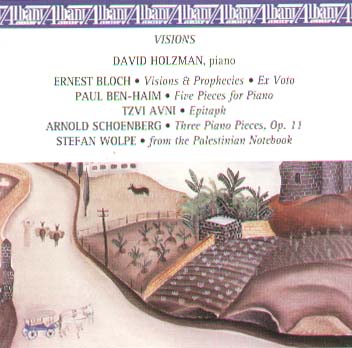
| Visions |
| Bloch: |
Visions and
Prophecies; Ex Voto* |
 |
| Ben-Haim: |
Five Pieces
for Piano |
| Avni: |
Epitaph* |
| Schoenberg: |
Drei
Klavierstucke (excerpts) |
| Wolpe: |
from the
Palestinian Notebook* (excerpts) |
|
Albany
Troy 283
|
| "This
fascinating recording presents piano music by Jewish composers of
three generations. In his brilliant performances, David Holzman
illuminates the many-sidedness and distinctiveness of the styles
heard here. The high artistic level of the material reaches from
Wolpe's Jewish folk miniatures which, in their aphoristic brevity
serve a much higher purpose than that of mere encores, to the
epochal abstraction of Schoenberg's op.11. I have rarely heard these
works so clearly illuminated and differentiated as here." |
|
—Knute
Franke, Fonoforum, Germany |
|
|
*premiere
recording
|
|
| Wolpe: |
Dance
in Form of a Chaconne (from Zemach Suite - 1939) (excerpts) |
| Wolpe: |
Stehendemusik
(from Sonata - 1925) (excerpts) |